
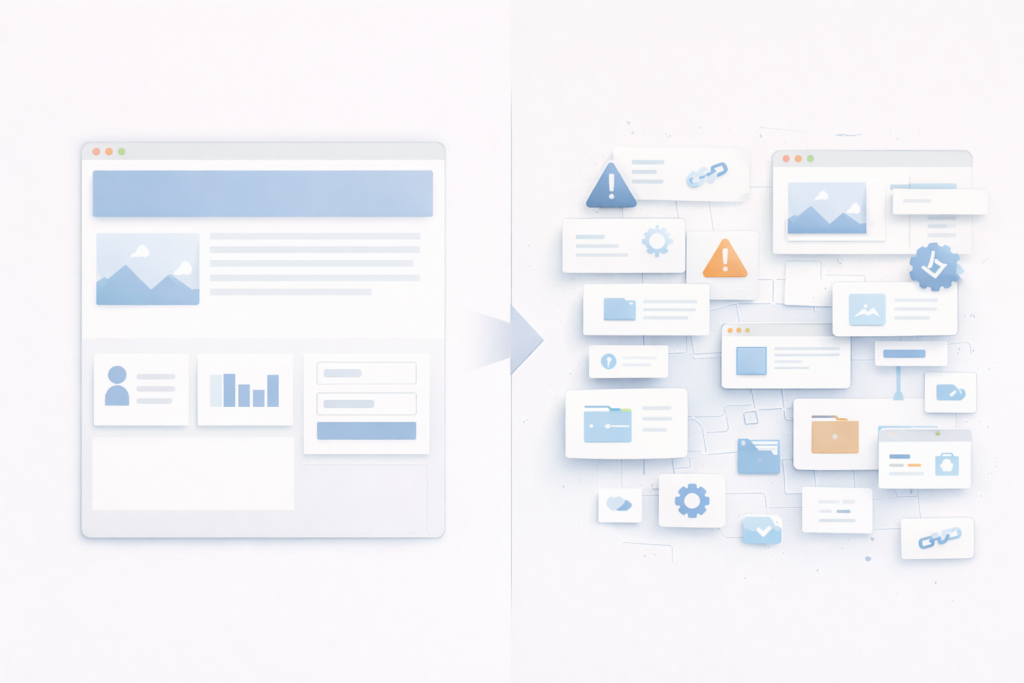
Most WordPress websites do not fail at launch.
They fail when they are asked to change.
At the point of delivery, everything appears complete. Pages are live, the design is approved, and functionality works as expected. The problems begin when the website needs to evolve.
This is where structure becomes visible.
Failure after launch is not caused by a single issue. It is the result of how the website was built from the beginning.
For a broader view of structural planning, see architecture.
What Post-Launch Failure Actually Looks Like
Failure is rarely immediate. It develops over time.
Small changes become difficult
Updating content, adding sections, or adjusting layouts takes longer than expected. Tasks that should be simple require more effort or technical input.
Inconsistencies begin to appear
Pages that should behave in the same way start to diverge. Layouts, spacing, and content structure become inconsistent.
Reliance on workarounds
Instead of making clean updates, temporary fixes are introduced. Over time, these become part of the system.
Why These Problems Appear After Launch
These issues are not introduced later. They were present from the start.
No defined content model
Content is created visually rather than structured. This makes it difficult to manage consistently.
Page-by-page construction
Each page is built individually. There is no shared system governing how pages should behave.
Lack of template logic
Templates are either missing or loosely defined. This leads to variation across similar content.
These patterns are closely related to why most wordpress websites fail.
The Role of Structure in Post-Launch Stability
A stable website is one that can change without breaking.
Predictable content behaviour
Structured systems ensure content behaves consistently across all pages.
Reusable templates
Templates allow updates to be applied across multiple pages, not just one.
Controlled editing environments
Content can be updated without affecting layout or functionality.
For a deeper explanation of system design, see systems.
How Post-Launch Issues Affect SEO
Structural issues impact more than usability.
Inconsistent hierarchy
Headings and content structure vary across pages, reducing clarity.
Fragmented internal linking
Links are added inconsistently, weakening the overall structure of the site.
Reduced crawl efficiency
Search engines rely on predictable patterns. Structural inconsistency makes indexing less efficient.
Why Fixing These Issues Becomes Difficult
Once a website is live, structural problems are harder to resolve.
Changes affect multiple areas
Without separation between content and layout, updates can introduce unintended issues.
Increasing technical debt
Each workaround adds complexity, making future changes more difficult.
Limited scalability
As the website grows, the effort required to manage it increases.
This often leads to the situation explored in is it time to rebuild your website instead of patching it.
Preventing Post-Launch Failure
Stability is not achieved through maintenance alone.
Define structure before design
Content models and relationships should be established early.
Build systems, not pages
Focus on reusable templates and consistent logic.
Plan for change
Websites should be designed to evolve without increasing complexity.
Websites rarely fail immediately after launch.
They fail when they are asked to evolve without a structure that supports change.