
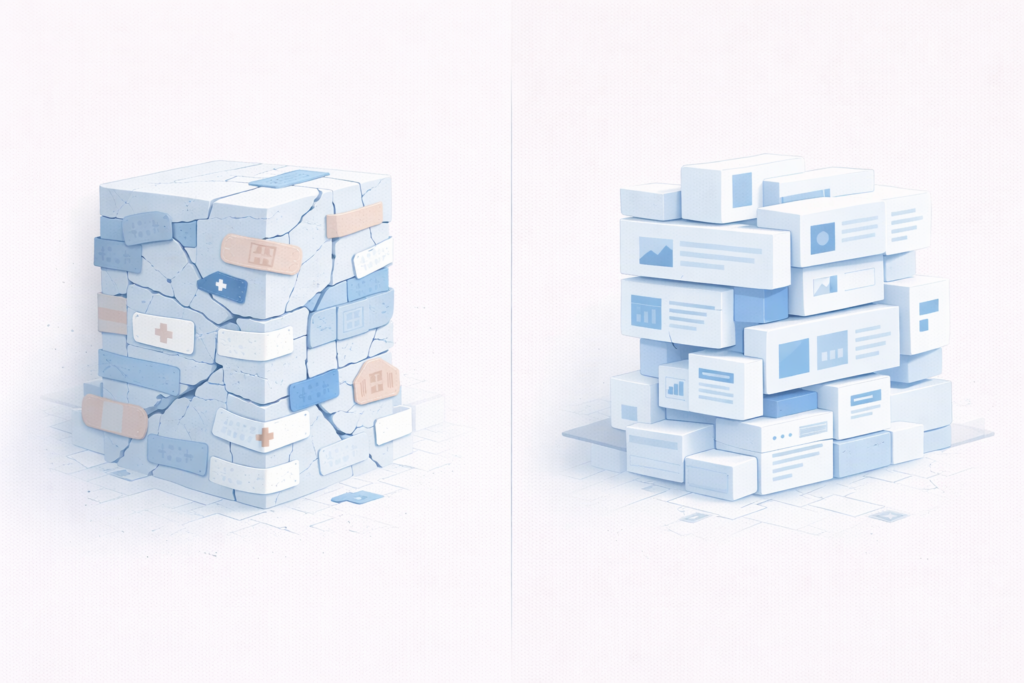
Most websites are not rebuilt too early.
They are rebuilt too late.
Before that point, effort is spent patching issues. Small fixes are applied to solve immediate problems. Over time, these patches accumulate, and the website becomes harder to manage.
The decision is not about whether the website still works.
It is about whether the structure can support ongoing change.
For a broader view of structural planning, see architecture.
What “Patching” Looks Like in Practice
Patching is often the default approach when issues appear.
Fixing symptoms instead of structure
Problems are addressed individually, without examining the underlying system.
Adding plugins to solve gaps
New functionality is introduced through plugins rather than structural changes.
Adjusting individual pages
Changes are made at the page level instead of through templates or system logic.
Why Patching Becomes Unsustainable
Patching can work in the short term.
Over time, it creates limitations.
Increasing complexity
Each fix adds another layer. The system becomes harder to understand and maintain.
Conflicting solutions
Different fixes may not work well together, creating instability.
Slower updates
Even small changes begin to require more effort.
These patterns are closely related to the issues outlined in /why-most-wordpress-websites-fail-after-12-18-months/.
Signs It May Be Time to Rebuild
Rebuilding is not always necessary.
Certain patterns indicate structural limits.
Changes affect multiple areas
Updating one part of the website causes unexpected issues elsewhere.
Inconsistent page behaviour
Similar pages do not follow the same structure or layout.
High maintenance effort
Routine updates require more time than expected.
Limited scalability
Adding new content or features becomes increasingly difficult.
The Difference Between Fixing and Rebuilding
Fixing focuses on individual problems.
Rebuilding focuses on the system.
Fixing
Addresses immediate issues without changing the underlying structure.
Rebuilding
Redefines how content is organised, connected, and managed.
This distinction is closely tied to scalability, as explained in what makes a wordpress website scalable.
When a Rebuild Is the Better Option
A rebuild becomes appropriate when structural issues limit progress.
Structural inconsistency
Content is not organised in a predictable way.
Accumulated technical debt
Past decisions make clean improvements difficult.
Lack of system control
Templates, relationships, and content models are not clearly defined.
Rebuilding as a Structural Reset
Rebuilding is not about starting over visually.
It is about redefining the system.
Define content models
Establish consistent structures for different types of content.
Create reusable templates
Ensure layouts are controlled at the system level.
Separate content from design
Allow content to be managed independently of layout.
For a deeper explanation of system design, see systems.
A Structural Perspective on the Decision
The decision to rebuild is not based on age or appearance.
It is based on structure.
If the system cannot support change without increasing complexity, rebuilding becomes the more stable option.
A website does not need to be replaced because it is old.
It needs to be rebuilt when its structure no longer supports how it needs to grow.