
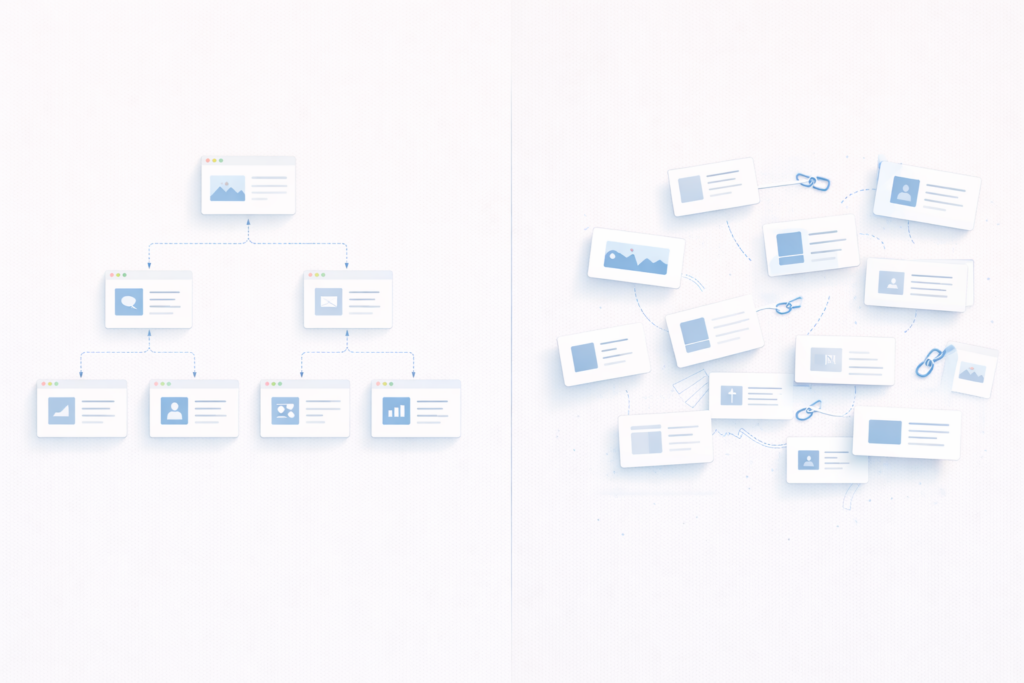
SEO issues are often approached as content or keyword problems.
In many cases, the issue is structural.
A website can have strong content and still underperform if the underlying structure is inconsistent. Search engines rely on predictable patterns. When those patterns are missing, performance is affected.
Structure does not replace SEO. It enables it.
For a broader view of structural planning, see architecture.
What “Structure” Means in SEO Terms
Structure determines how content is organised and understood across the website.
Content hierarchy
Headings, sections, and page organisation should follow a consistent pattern. This helps search engines interpret the importance and relationship of content.
URL and page relationships
Pages should be grouped logically, with clear relationships between related topics.
Internal linking
Links between pages should reflect the structure of the website, not be added randomly.
Common Signs Your Structure Is Hurting SEO
Structural issues are often visible in how the website behaves.
Inconsistent headings
Pages use different heading levels for similar content, making hierarchy unclear.
Duplicate or overlapping content
Without clear structure, similar topics are repeated across multiple pages.
Weak internal linking
Important pages are not consistently linked, while less relevant pages may be overlinked.
These patterns are closely related to the issues outlined in why most wordpress websites fail.
Why Structural Issues Affect Search Performance
Search engines rely on consistency to understand content.
Reduced clarity
When pages are structured differently, it becomes harder to determine their purpose.
Inefficient crawling
Inconsistent linking and page relationships make it harder for search engines to navigate the site.
Diluted authority
When similar content is spread across multiple pages, authority is not consolidated.
The Difference Between On-Page SEO and Structure
On-page SEO focuses on individual pages.
Structure focuses on how pages relate to each other.
On-page SEO
Includes keywords, headings, and content optimisation within a page.
Structural SEO
Defines how content is organised across the entire website.
Both are important, but structure determines how effective on-page optimisation can be.
This distinction is explored further in technical seo vs on page seo what businesses get wrong.
How Structured Systems Improve SEO
Structured websites provide consistent signals.
Standardised templates
Pages follow the same layout and hierarchy, making them easier to interpret.
Defined content relationships
Content is connected logically, supporting internal linking and topical relevance.
Predictable metadata
Fields ensure metadata is applied consistently across all pages.
For a deeper explanation of system behaviour, see systems.
Identifying Structural Limitations
Structural issues are not always obvious at first.
Difficulty adding new content
If new pages require layout decisions, structure is likely missing.
Inconsistent page behaviour
If similar pages look or function differently, the system is not clearly defined.
Reliance on manual fixes
Frequent adjustments to individual pages indicate a lack of system-level control.
Structure as the Foundation of SEO
SEO improvements often focus on optimisation.
Structure focuses on organisation.
Without structure, optimisation becomes inconsistent. With structure, SEO becomes more predictable and scalable.
SEO does not fail because of missing keywords.
It fails when the website structure does not support how content should be understood.