
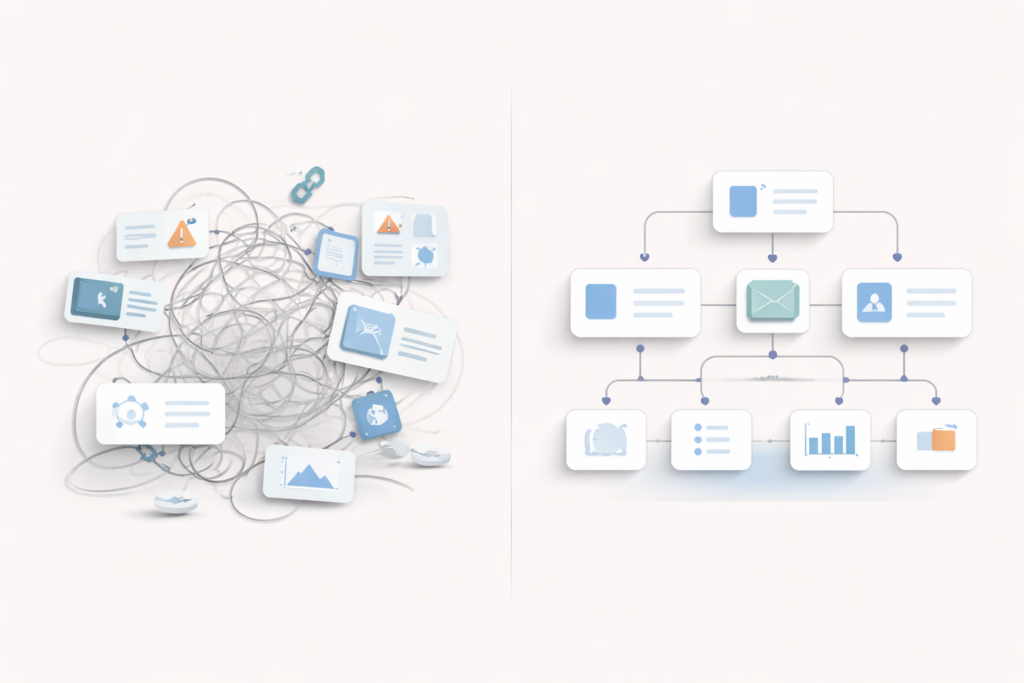
Most WordPress websites do not fail because of design.
They fail because of structure.
At launch, everything appears complete. Pages are live, content is in place, and functionality works. Over time, issues begin to surface. Updates become slower, inconsistencies appear, and performance declines.
These problems are not random. They are structural.
Understanding why websites fail requires looking beyond individual pages and focusing on how the system is built.
For a deeper explanation of structural planning, see architecture.
What “Failure” Actually Means in WordPress
Failure is rarely immediate or visible.
Gradual decline
Websites continue to function, but become harder to manage. Simple changes require more effort.
Inconsistent behaviour
Pages that should follow the same pattern begin to diverge in layout and structure.
Increasing maintenance
More time is spent fixing issues rather than improving the website.
Failure is not a single event. It is a gradual loss of stability.
The Core Reason WordPress Websites Fail
Most websites are assembled, not structured.
Page-first thinking
Pages are created individually, without defining how they relate to each other.
No content model
Content is added visually rather than organised into consistent fields and types.
Tool-driven decisions
Themes and plugins shape the website instead of supporting a defined structure.
This is closely related to the distinction explained in architecture vs assembly wordpress.
How Structural Issues Develop Over Time
Structural problems are not always visible at launch.
Early-stage flexibility
At the beginning, flexibility seems beneficial. Pages can be created quickly.
Mid-stage inconsistency
As more content is added, patterns begin to break. Similar pages no longer behave consistently.
Late-stage complexity
The website becomes difficult to update. Changes introduce new issues.
This progression is explored further in why most WordPress websites fail after 12 – 18 months.
The Impact on SEO and Performance
Structural issues affect more than maintenance.
Inconsistent page signals
Headings, metadata, and hierarchy vary across pages, reducing clarity for search engines.
Weak internal linking
Without defined relationships, content is not connected effectively.
Reduced scalability
Adding new content does not strengthen the website. It increases complexity.
For more on structural SEO, see how to know if your website structure is hurting your seo.
What To Do Instead: A Structured Approach
Preventing failure is not about fixing issues later. It is about defining structure early.
Define content models
Organise content into clear types with consistent fields.
Build reusable templates
Ensure pages are generated from structured templates rather than built individually.
Separate content from design
Allow content to be managed independently from layout.
Plan for scalability
Design the system to support growth without increasing complexity.
For a deeper view of system behaviour, see systems.
Structure Determines Longevity
Websites that are assembled rely on continuous fixes.
Websites that are structured rely on consistent systems.
The difference is not visible at launch.
It becomes clear over time.
A System-Level Perspective
A website is not a collection of pages.
It is a system.
When that system is defined clearly, the website remains stable, scalable, and maintainable.
When it is not, failure becomes a matter of time.
Websites do not fail because they are built on WordPress.
They fail because structure was never defined.