What WordPress Support Should Include
Ongoing WordPress support is often misunderstood.
It is usually defined as maintenance. Updates are applied, backups are taken, and security is monitored.
These tasks are necessary, but they do not address the underlying system.
Support should not only keep a website running. It should ensure the structure continues to function as intended over time.
For a broader view of structural planning, see architecture.
What Most Support Plans Focus On
Most support is operational.
Plugin and core updates
Keeping WordPress and its plugins up to date to maintain compatibility and security.
Backups and monitoring
Ensuring the website can be restored if something fails.
Basic fixes
Addressing issues as they appear, often reactively.
These are important, but they do not improve the system itself.
Where Traditional Support Falls Short
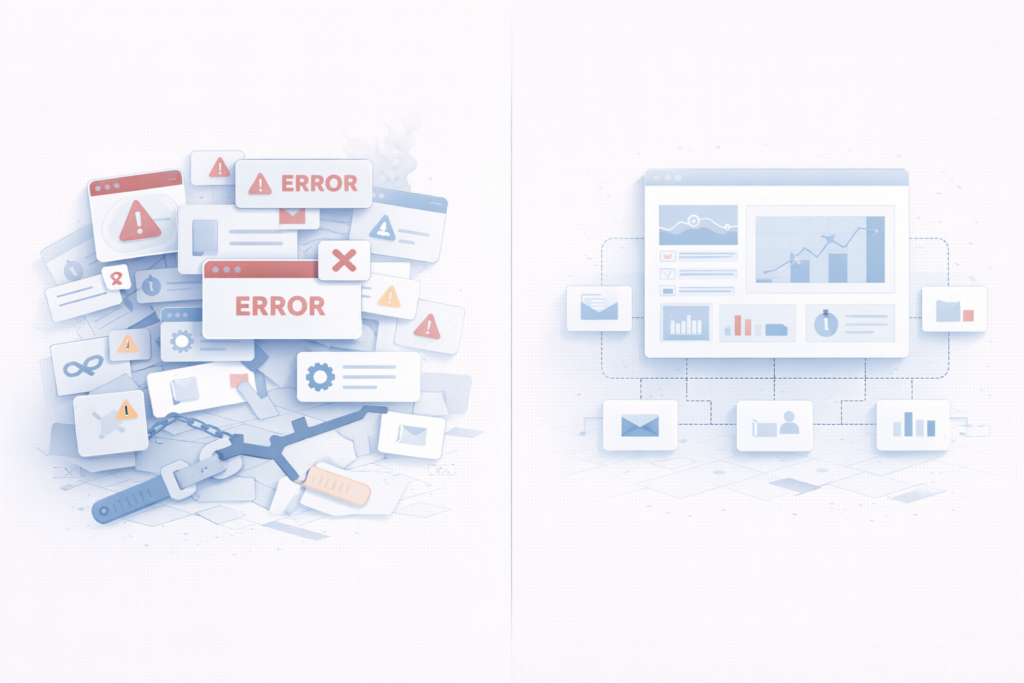
Operational support maintains the current state. It does not address structural issues.
No structural oversight
There is no review of how content is organised or how the system is evolving.
Reactive problem-solving
Issues are fixed after they appear, rather than prevented through structure.
Increasing complexity over time
Without structural control, the website gradually becomes harder to manage.
These patterns are closely related to the issues outlined in why most wordpress websites fail after launch.
What Structured Support Should Include
Support should extend beyond maintenance into system management.
Structural consistency checks
Reviewing whether new content follows the same structure as existing content.
Template and system integrity
Ensuring templates remain consistent and are not overridden by page-level changes.
Controlled changes
Implementing updates in a way that aligns with the existing system, rather than introducing exceptions.
For a deeper explanation of system behaviour, see systems.
Supporting Scalability Over Time
Support plays a role in whether a website can continue to grow.
Managing content expansion
New pages and sections should follow defined content models.
Maintaining internal relationships
Links and content connections should remain logical and consistent.
Preventing structural drift
Over time, small deviations can accumulate. Structured support prevents this.
This is closely tied to scalability, as explained in what makes a wordpress website scalable.
The Difference Between Maintenance and Support
Maintenance keeps the website running.
Support ensures the system remains stable.
Maintenance
Focuses on updates, backups, and uptime.
Support
Focuses on structure, consistency, and long-term behaviour.
Both are necessary, but they serve different purposes.
Why Support Should Be Ongoing
Structure is not a one-time decision.
It needs to be maintained as the website evolves.
New content introduces variability
Without oversight, new pages may not follow existing patterns.
Changes can affect structure
Even small updates can introduce inconsistencies if not managed carefully.
Growth increases complexity
As the website expands, maintaining structure becomes more important.
A Structural View of Support
Support should not be measured by how many tasks are completed.
It should be measured by how stable the system remains.
A well-supported website becomes easier to manage over time, not more difficult.
A website does not remain effective because it is maintained.
It remains effective because its structure is consistently protected as it grows.