
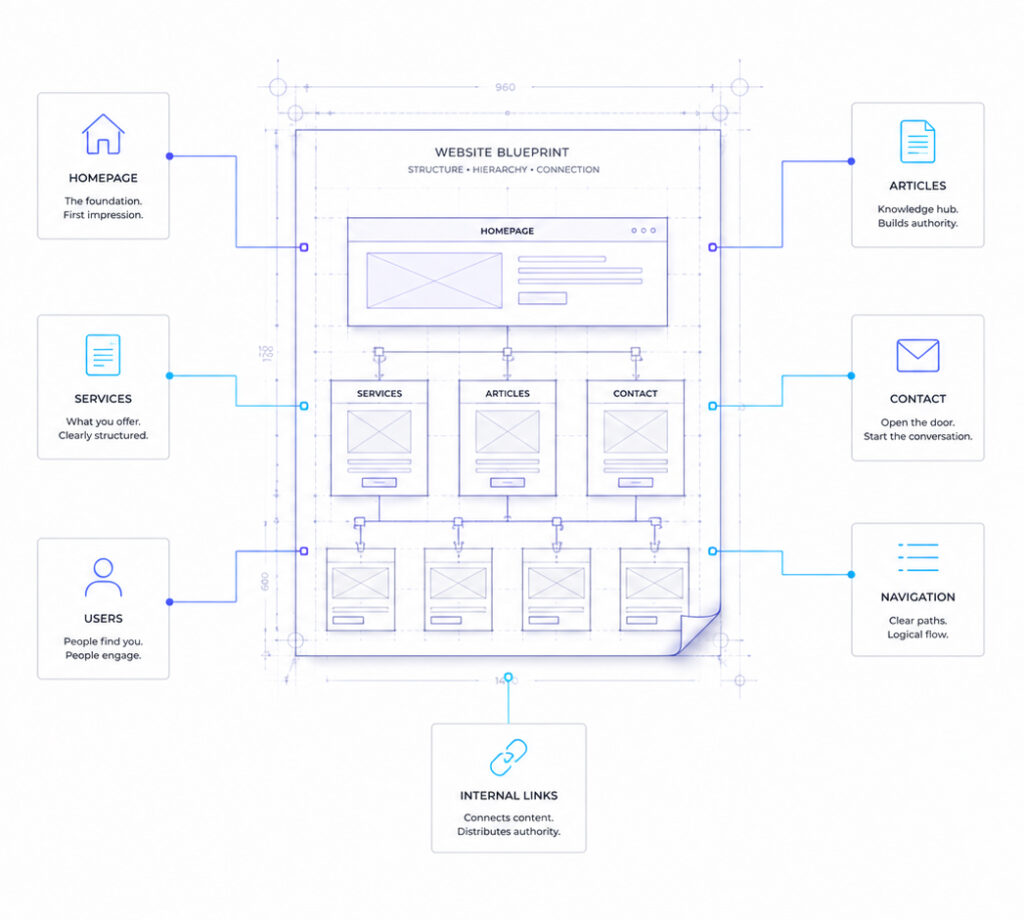
Many businesses believe a successful website begins with design
In reality, it begins with structure.
Before colours are chosen, before images are added and before content is written, there must be a clear plan for how information will be organised.
This is Website Architecture.
Website Architecture defines how pages relate to one another, how visitors navigate your website and how search engines and AI systems understand your business.
A beautifully designed website with poor architecture can confuse users, weaken search performance and limit future growth.
A well-architected website, by contrast, creates clarity.
It helps visitors find information quickly, supports search visibility, strengthens AI understanding and provides a scalable foundation for your business.
For SparkiWeb, Website Architecture is one of the core pillars of Digital Visibility Architecture™.
What Is Website Architecture?
Website Architecture is the logical structure of a website.
It determines:
- how information is organised
- how pages are connected
- how users navigate the site
- how search engines crawl content
- how AI systems understand relationships between topics
Think of it as the blueprint for your digital presence.
Just as a building requires architectural plans before construction begins, a website benefits from a clear structure before design and development.
Why Website Architecture Matters
A website exists to help people achieve a goal.
Whether someone wants to learn about your services, contact your business or make a purchase, they should be able to find the information they need without confusion.
Good Website Architecture supports:
- Better user experience
- Clear navigation
- Faster information discovery
- Stronger search visibility
- Improved AI Visibility
- Easier website maintenance
- Future scalability
Without a clear structure, even high-quality content can become difficult to find and difficult to understand.
Website Architecture and Digital Visibility
Search engines and AI systems rely on structure to interpret your website.
A logical architecture helps them understand:
- your services
- your expertise
- the relationships between topics
- the importance of individual pages
This strengthens your overall Digital Visibility.
For example, a structured hierarchy might look like this:
Home

↓

Digital Visibility Architecture™

↓

AI Visibility

↓

Website Architecture

↓

Technical SEO

↓

Website Systems

↓

Google Business Profile

↓

Business Growth
Each page supports the others through meaningful internal links.
This creates a connected knowledge ecosystem rather than a collection of isolated pages.
The Core Principles of Good Website Architecture
Clarity
Visitors should immediately understand:
- who you are
- what you do
- who you help
- what they should do next
Every page should contribute to answering these questions.
If visitors hesitate because information is unclear, the architecture should be reviewed.
Simplicity
Simple websites are often more effective than complicated ones.
Avoid:
- unnecessary menu items
- duplicate pages
- confusing navigation
- excessive dropdown menus
Every page should exist for a clear purpose.
Logical Hierarchy
Information should be organised from broad topics to more specific topics.
For example:
Digital Visibility
↓
AI Visibility
↓
↓
Structured Data
This hierarchy makes navigation intuitive for users while helping search engines and AI understand topical relationships.
Consistency
Navigation, headings and page layouts should follow consistent patterns.
Consistency reduces cognitive effort for users and strengthens the website’s overall structure.
Scalability
Your website should accommodate future growth.
As your business expands, new services, articles and resources should fit naturally into the existing architecture without requiring a complete redesign.
Good architecture is designed to evolve.
Common Website Architecture Mistakes
Many websites struggle because they lack a clear structural plan.
Common issues include:
Too Many Top-Level Pages
When every page competes for equal importance, visitors struggle to know where to begin.
A clear hierarchy helps users navigate more efficiently.
Duplicate Content
Creating multiple pages covering the same topic confuses both users and search engines.
Each important topic should have one authoritative page
Poor Internal Linking
Pages should connect naturally to related content.
Internal links help users continue learning while strengthening topical authority.
Navigation Built Around the Business
Many websites organise navigation around internal departments rather than customer needs.
Navigation should reflect how customers think, not how the business is organised.
Designing Before Planning
Visual design should enhance architecture – not replace it.
Without a structural plan, design alone cannot solve usability problems.
Website Architecture and AI Visibility
Artificial intelligence relies heavily on context and relationships.
A well-structured website helps AI systems understand:
- primary topics
- supporting topics
- service relationships
- business expertise
- content hierarchy
This improves the likelihood that AI systems accurately interpret and reference your business.
Website Architecture therefore plays a direct role in AI Visibility.
Website Architecture and WordPress
WordPress provides an excellent platform for implementing structured architecture when configured correctly.
This includes:
- logical page hierarchies
- meaningful URLs
- categories
- internal linking
- structured navigation
- reusable templates
The platform itself is only a tool.
Its effectiveness depends on how thoughtfully it is organised.
Website Architecture Is an Investment
Businesses often redesign websites every few years because their existing sites become difficult to manage.
This is frequently an architectural problem rather than a design problem.
A well-planned structure remains valuable long after visual trends change.
Instead of rebuilding repeatedly, businesses can continue expanding an architecture that already supports growth.
Conclusion
Website Architecture is one of the most important yet overlooked aspects of digital success.
It influences how customers navigate your website, how search engines interpret your content and how AI systems understand your expertise.
When structure comes first, design becomes more effective, content becomes easier to organise and future growth becomes easier to manage.
Rather than viewing Website Architecture as a technical exercise, it should be recognised as the foundation upon which every successful digital ecosystem is built.
Frequently Asked Questions
What is Website Architecture?
Website Architecture is the logical structure of a website, including how pages are organised, connected and presented to users and search engines.
Is Website Architecture the same as web design?
No. Website Architecture focuses on structure and organisation, while web design focuses on visual presentation and user interface.
Does Website Architecture affect SEO?
Yes. A clear structure helps search engines crawl, understand and index your content more effectively, supporting stronger search visibility.
Does Website Architecture influence AI Visibility?
Yes. AI systems rely on clear relationships between topics, services and content. A well-structured website makes these relationships easier to understand.
Can an existing website be improved without rebuilding it?
Often, yes. Many websites can achieve significant improvements by restructuring navigation, refining content and strengthening internal linking without requiring a complete redesign.
Ready to Build a Stronger Website?
A successful website is more than an attractive design.
It is a carefully planned system that helps people discover your business, understand your expertise and take the next step with confidence.
If you’re unsure whether your current website structure supports long-term growth, a Website Audit can identify opportunities to improve navigation, strengthen content relationships and create a stronger foundation for search visibility and AI Visibility.