
Building an Online Business That Is Easier to Discover, Easier to Trust and Easier to Choose
Most businesses invest in digital marketing with the expectation that each new service will improve their visibility.
They commission a website.
They invest in SEO.
They create a Google Business Profile.
They publish content.
They advertise on Google or social media.
Individually, each of these activities can provide value. Yet many businesses still struggle to generate consistent enquiries, attract qualified customers or build lasting online authority.
The problem is rarely the individual services.
The problem is that they are often delivered as separate activities rather than as parts of a connected system.
Digital Visibility Architecture™ was developed to solve this challenge.
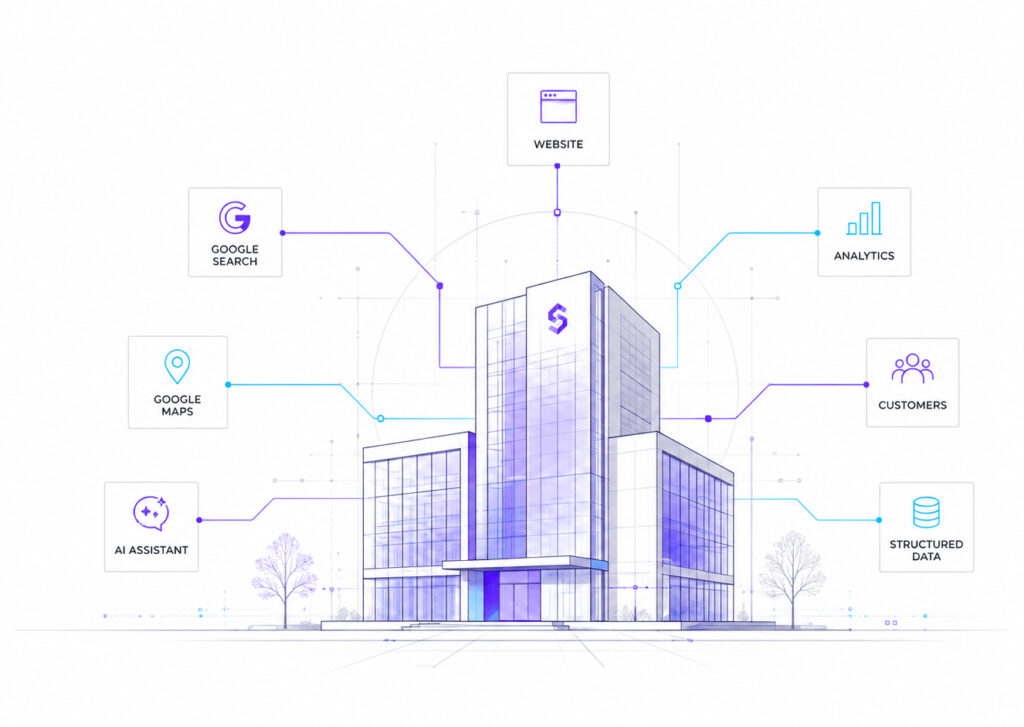
Rather than treating websites, search optimisation, Google Business Profiles, AI visibility and content as independent disciplines, Digital Visibility Architecture™ views them as interconnected components of a single digital ecosystem with one objective:
Helping businesses become easier to discover, easier to trust and easier to choose.
Instead of asking:
“How can we improve SEO?”
Digital Visibility Architecture™ asks:
“How can we improve the entire digital ecosystem that influences how people and search technologies discover, understand and trust this business?”
That difference fundamentally changes how long-term digital growth is achieved.
What Is Digital Visibility Architecture™?
Digital Visibility Architecture™ is the professional practice of designing, improving and maintaining a business’s complete digital visibility ecosystem.
It combines multiple disciplines into one integrated framework, including:
- Website Architecture
- Technical Engineering
- Search Visibility
- AI Readiness
- Structured Data
- User Experience
- Business Strategy
Rather than optimising each discipline independently, every improvement is evaluated according to how it strengthens the overall ecosystem.
For example, improving your website structure does more than make navigation easier.
It also improves:
- Search engine understanding
- AI interpretation
- User experience
- Internal linking
- Content relationships
- Conversion potential
- Customer trust
One improvement benefits multiple systems simultaneously.
That is architecture.
Why Digital Visibility Architecture™ Exists
The digital landscape has become increasingly fragmented.
Businesses are commonly offered services such as:
- Website design
- SEO
- Google Business Profile management
- Content marketing
- AI optimisation
- Structured data implementation
While each service has value, they are frequently delivered in isolation.
The result is often:
- inconsistent messaging
- duplicated effort
- technical debt
- disconnected customer journeys
- missed opportunities
- poor long-term scalability
Many businesses end up owning a collection of digital assets rather than a connected digital ecosystem.
Digital Visibility Architecture™ was created to replace fragmented digital marketing with one integrated architectural approach that considers how every digital component supports the others.
Why Traditional Digital Marketing Is No Longer Enough
For many years, digital marketing focused on channels.
One agency managed SEO.
Another handled social media.
Someone else built the website.
Advertising was managed separately.
Content was outsourced.
Each provider measured success within their own discipline.
Very few asked whether the complete system was becoming stronger.
This channel-first mindset often creates several problems.
Disconnected User Experiences
A customer may discover your business through Google Search, click through to your website and immediately encounter confusing navigation, inconsistent messaging or outdated information.
Your SEO may have succeeded.
Your digital ecosystem has failed
Technical Debt
Short-term optimisation often introduces unnecessary plugins, duplicated pages, poor website structure and inconsistent content.
These issues accumulate over time, making future improvements slower, more expensive and more complex.
Inconsistent Trust Signals
Customers evaluate businesses using many signals simultaneously.
These include:
- website quality
- Google reviews
- local listings
- page speed
- content quality
- brand consistency
- expertise
- AI-generated summaries
Weakness in one area reduces confidence across the entire experience.
AI Has Changed Digital Discovery
Search is no longer limited to traditional search engines.
Businesses are increasingly discovered through:
- AI assistants
- conversational search
- Google AI experiences
- recommendation systems
- knowledge graphs
- local search
- voice interfaces
These technologies reward businesses that communicate clearly, organise information effectively and demonstrate authority across their digital ecosystem rather than relying on isolated optimisation techniques.
The Philosophy Behind Digital Visibility Architecture™
Digital Visibility Architecture™ is built on a simple principle:
Digital visibility is engineered.
It is not created by a single tactic.
It is the combined outcome of multiple systems working together.
At SparkiWeb, every recommendation supports the same progression:
Trust → Clarity → Authority → Visibility → Conversion → Sustainable Growth
Optimising visibility without first establishing trust creates fragile results.
Improving rankings without improving user experience limits commercial value.
Generating traffic without building authority reduces long-term growth.
Architecture ensures every improvement strengthens the entire ecosystem rather than one isolated metric.
Why Architecture Matters More Than Optimisation
Optimisation improves existing systems.
Architecture determines whether those systems work together in the first place.
Imagine constructing a commercial building.
Painting the walls will not compensate for weak foundations.
Replacing the furniture will not solve poor structural design.
Similarly, adding more keywords, publishing more articles or running additional advertising campaigns cannot compensate for weak digital architecture.
Digital Visibility Architecture™ focuses on strengthening the underlying structure first.
When the architecture improves:
- SEO becomes more effective.
- AI systems understand your business more clearly.
- Users navigate with greater confidence.
- Conversion rates improve naturally.
- Future growth becomes easier to sustain.
This is why Digital Visibility Architecture™ prioritises architecture before optimisation and systems before channels as foundational principles.
The Six Layers of Digital Visibility™
Digital Visibility Architecture™ is built on six interconnected layers.
Each layer supports the others.
Strengthening only one layer may produce short-term improvements, but sustainable growth happens when all six work together as an integrated system.
Layer 1: Website Experience
Your website is the foundation of your digital ecosystem.
It is where potential customers validate what they discovered elsewhere.
A business may appear prominently in Google Search or receive recommendations from AI systems, but if the website is confusing, outdated or difficult to use, confidence quickly declines.
Website experience is about much more than appearance.
It includes:
- Information architecture
- Navigation
- Content hierarchy
- Mobile usability
- Accessibility
- Performance
- Conversion pathways
- User confidence
Every page should answer four fundamental questions:
- Who are you?
- What do you do?
- Why should I trust you?
- What should I do next?
If any of these answers are unclear, digital visibility suffers because customers—and increasingly AI systems—struggle to understand your business.
A well-designed website is therefore not simply attractive.
It is intentionally structured to communicate clarity, authority and purpose.
Related articles: Website Architecture
Layer 2: Search Visibility
Search visibility remains an essential component of digital growth.
However, search visibility is no longer achieved simply by targeting keywords.
Modern search engines evaluate:
- Relevance
- Expertise
- Technical quality
- Content relationships
- Internal linking
- Structured data
- User satisfaction
- Website performance
Search visibility therefore becomes an outcome of strong architecture rather than isolated SEO tactics.
This is why businesses that continually chase rankings without improving their underlying website often experience inconsistent results.
Digital Visibility Architecture™ focuses on building a website that deserves visibility because it provides clarity, authority and value.
Related article: Technical SEO
Layer 3: Google Business Profile
For businesses serving a geographic area, Google Business Profile is often one of the most influential visibility assets.
It affects how businesses appear in:
- Google Maps
- Local Search
- Mobile searches
- AI-generated local recommendations
A well-managed Google Business Profile supports:
- Local discovery
- Customer trust
- Review acquisition
- Service visibility
- Business credibility
However, Google Business Profile should never operate independently of the website.
Consistency across both platforms strengthens Google’s confidence in your business and creates a better experience for potential customers.
Digital Visibility Architecture™ therefore treats Google Business Profile as an integrated component of the wider ecosystem rather than a standalone marketing activity.
Related article: Google Business Profile
Layer 4: AI Visibility
Search behaviour is evolving rapidly.
Increasingly, customers receive answers directly from AI assistants instead of browsing multiple websites.
These systems do not simply rank pages.
They interpret information.
They identify entities.
They compare businesses.
They summarise expertise.
They recommend trusted sources.
AI Visibility focuses on helping your business communicate in ways that are easier for AI systems to understand accurately.
This includes:
- Clear content structure
- Consistent terminology
- Strong topical authority
- Well-defined entities
- Logical internal linking
- Structured data
- High-quality supporting content
Businesses that invest in AI Visibility are not optimising for one platform.
They are improving how their business is interpreted across an expanding ecosystem of AI-powered search experiences.
Related article: AI Visibility
Layer 5: Trust Signals
Visibility creates opportunities.
Trust converts them.
Customers evaluate trust continuously before deciding whether to contact a business.
These trust signals include:
- Professional branding
- Consistent messaging
- Reviews and testimonials
- Case studies
- Helpful educational content
- Transparent pricing
- Security
- Fast-loading pages
- Accurate contact information
- Clear expertise
Search engines and AI systems also evaluate many of these signals because they help indicate reliability.
Digital Visibility Architecture™ therefore treats trust as a measurable architectural layer rather than an abstract branding exercise.
When trust improves, visibility becomes more commercially valuable.
Layer 6: Continuous Growth
Digital visibility is never finished.
Search technologies evolve.
Customer expectations change.
Competitors improve.
AI platforms introduce new ways of discovering information.
Businesses therefore need ongoing refinement rather than one-off optimisation.
Continuous Growth includes:
- Monitoring performance
- Improving content
- Expanding topical authority
- Refining website architecture
- Updating technical foundations
- Strengthening internal linking
- Enhancing local visibility
- Responding to technological change
Rather than chasing constant redesigns, Digital Visibility Architecture™ promotes continuous, measured improvement that strengthens the existing ecosystem over time.
Why These Layers Work Together
One of the defining characteristics of Digital Visibility Architecture™ is that every improvement creates benefits across multiple layers.
For example:
| Improvement | Benefits |
|---|---|
| Better website architecture | Improves usability, SEO, AI understanding and conversions |
| Structured content | Supports search visibility, AI interpretation and trust |
| Google Business optimisation | Improves local discovery and reinforces business credibility |
| Faster website performance | Improves user experience, technical SEO and engagement |
| Educational cornerstone content | Builds authority, attracts organic traffic and strengthens AI Visibility |
Rather than viewing these as separate initiatives, Digital Visibility Architecture™ coordinates them into a connected system where each improvement increases the effectiveness of the others.
This systems-first approach is what distinguishes architecture from traditional digital marketing.
Visibility Is an Outcome, Not a Service
Many businesses ask:
“What service do I need?”
Digital Visibility Architecture™ starts with a different question:
“What is preventing customers from discovering, understanding and trusting my business?”
The answer is rarely one isolated issue.
It is usually a combination of structural weaknesses across several layers of the digital ecosystem.
That is why lasting visibility is not purchased through a single service.
It is engineered through thoughtful architecture, continuous improvement and connected systems that work together toward a common objective.
How Digital Visibility Architecture™ Is Implemented
Understanding Digital Visibility Architecture™ is only the first step.
The real value lies in applying it through a structured, repeatable methodology.
At SparkiWeb, every engagement follows the same proven framework.
This ensures recommendations are based on evidence rather than assumptions, priorities are clearly defined, and improvements build on one another over time.
Rather than jumping directly into implementation, we first seek to understand the business, its customers and its objectives.
This systematic approach helps reduce technical debt, prevents unnecessary work and creates a stronger foundation for long-term growth. It reflects the Visibility Growth Framework™, which defines a repeatable six-phase process from Discovery through Continuous Growth.
Phase 1: Discovery
Every successful digital strategy begins with understanding the business.
Before making recommendations, we take time to understand:
- Your business objectives
- Your products and services
- Your ideal customers
- Your competitive landscape
- Your current digital presence
- Your long-term growth ambitions
Many businesses assume they need a new website or an SEO campaign.
In reality, these are solutions, not objectives.
The Discovery phase helps identify the underlying business challenges before any technical work begins.
Typical questions include:
- How do customers currently find you?
- What differentiates your business?
- Which services generate the greatest value?
- What challenges are limiting growth?
- What would success look like in 12 months?
By understanding the business first, we ensure every recommendation supports commercial objectives rather than simply improving technical metrics.
Phase 2: Visibility Audit
Once the business is understood, the next step is to assess the current digital ecosystem.
A Visibility Audit examines how well the different components of your online presence work together.
This typically includes:
- Website architecture
- Technical health
- Website performance
- Content quality
- Google Business Profile
- Search visibility
- AI readiness
- Internal linking
- User experience
- Trust signals
Rather than producing a list of technical issues, the audit identifies:
- Strengths
- Weaknesses
- Quick wins
- Strategic opportunities
- Long-term priorities
This evidence-based approach prevents guesswork and creates a clear starting point for improvement.
Phase 3: Strategy
Once the current position is understood, improvements are prioritised into a practical roadmap.
Not every recommendation needs to happen immediately.
Some changes deliver immediate value.
Others strengthen the long-term foundation.
A well-structured strategy typically includes:
- Immediate priorities
- Short-term improvements
- Long-term initiatives
- Expected outcomes
- Recommended sequencing
The objective is to ensure that each improvement supports the next, creating cumulative progress rather than isolated successes.
Phase 4: Implementation
Implementation is where strategy becomes reality.
Depending on the needs of the business, this may include:
- Website improvements
- Navigation refinement
- Technical SEO
- Google Business Profile optimisation
- Structured data implementation
- Internal linking
- Content optimisation
- AI readiness enhancements
- Performance improvements
- Accessibility improvements
Importantly, implementation follows the architectural plan established during the earlier phases.
This avoids introducing unnecessary complexity or creating technical debt.
Every improvement should strengthen the digital ecosystem rather than simply ticking off individual tasks.
Phase 5: Validation
Implementation alone does not guarantee success.
Every improvement should be tested and validated.
Validation typically includes:
- Technical testing
- Website performance
- Accessibility checks
- Structured data validation
- Search visibility verification
- AI readiness review
- Quality assurance
This phase confirms that recommendations have been implemented correctly and are delivering the intended outcomes.
Validation also provides confidence that the digital ecosystem remains stable as it evolves.
Phase 6: Continuous Growth
Digital visibility is not a one-time project.
Search engines evolve.
Artificial intelligence continues to develop.
Customer behaviour changes.
Competitors improve.
Maintaining visibility therefore requires continuous refinement.
Ongoing activities may include:
- Technical maintenance
- Website optimisation
- Google Business Profile updates
- New educational content
- Internal linking improvements
- Performance monitoring
- AI visibility enhancements
- Quarterly strategic reviews
Rather than constantly rebuilding websites or chasing algorithm updates, Digital Visibility Architecture™ focuses on steady, sustainable improvement.
Each enhancement builds upon the previous one, creating long-term momentum rather than short-term spikes in performance.
The Role of SparkiScore™
To support continuous improvement, SparkiWeb uses the SparkiScore™, a proprietary assessment framework designed to measure the overall health of a business’s digital visibility ecosystem.
Unlike traditional SEO audits that focus primarily on rankings or keywords, SparkiScore™ evaluates multiple dimensions of digital maturity.
These include:
- Technical Foundation
- Website Experience
- Search Visibility
- AI Readiness
- Trust
- Authority
Each category contributes to an overall score, providing a clear picture of where a business performs well and where opportunities for improvement exist. Every recommendation is evidence-based and prioritised according to business impact, helping organisations focus on meaningful progress rather than isolated metrics
Why a Structured Methodology Matters
Many digital projects fail because implementation begins before understanding.
Businesses invest in redesigns without reviewing user journeys.
They publish content without a content strategy.
They optimise for search without improving trust.
They install plugins instead of solving root problems.
Digital Visibility Architecture™ avoids these pitfalls by following a structured methodology where every phase builds upon the last.
The result is a digital ecosystem that is:
- Easier to maintain
- Easier to scale
- Easier for customers to understand
- Easier for search engines to interpret
- Easier for AI systems to recommend
Most importantly, it creates a stronger foundation for sustainable business growth.
Bringing It All Together
Digital Visibility Architecture™ is more than a methodology – it is a long-term approach to building a digital presence that adapts as technology and customer expectations evolve.
Instead of treating websites, SEO, Google Business Profiles and AI visibility as separate services, it connects them into a single, integrated system.
When these elements work together, businesses become:
- Easier to discover through search engines, maps and AI-powered search.
- Easier to trust through clear messaging, technical quality and consistent authority signals.
- Easier to choose because customers can quickly understand who you are, what you do and why they should work with you.
That is the purpose of Digital Visibility Architecture™.
It is not about chasing rankings or reacting to algorithms.
It is about engineering a digital ecosystem that supports sustainable business growth—today and into the future.
Frequently Asked Questions About Digital Visibility Architecture™
The following questions address some of the most common topics business owners ask when they begin improving their digital visibility.
What is Digital Visibility Architecture™?
Digital Visibility Architecture™ is SparkiWeb’s structured methodology for helping businesses become easier to discover, easier to trust and easier to choose online.
Rather than treating SEO, websites, Google Business Profile and AI Visibility as separate services, it combines them into one connected digital ecosystem that supports long-term business growth.
How is Digital Visibility Architecture™ different from SEO?
SEO focuses primarily on improving visibility within search engines.
Digital Visibility Architecture™ is broader.
It considers every aspect of your online presence, including:
- Website Architecture
- Technical SEO
- Google Business Profile
- AI Visibility
- Website Systems
- Content Strategy
- Trust Signals
- Authority Building
- User Experience
SEO is an important layer within the architecture, but it is not the architecture itself.
Why isn’t SEO enough anymore?
Search has evolved significantly.
Today, customers discover businesses through:
- Google Search
- Google Maps
- AI assistants
- Voice search
- Local search
- Recommendation engines
- Social platforms
Optimising for Google alone means missing opportunities across these additional discovery channels.
Businesses need a broader strategy that supports visibility wherever potential customers are searching.
What is AI Visibility?
AI Visibility focuses on helping artificial intelligence systems accurately understand, interpret and recommend your business.
Rather than optimising for rankings alone, AI Visibility improves:
- Information clarity
- Website structure
- Entity relationships
- Structured data
- Content quality
- Trust signals
These improvements help AI systems confidently reference your business when answering users’ questions.
Do I need a new website?
Not necessarily.
Many businesses can significantly improve their digital visibility by strengthening their existing website.
In some cases, a redesign or rebuild may be recommended, but this should always be based on evidence rather than assumptions.
A Visibility Audit helps determine the most appropriate approach.
What role does Google Business Profile play?
Google Business Profile is a critical component of local visibility.
It helps businesses appear in:
- Google Maps
- Local Search
- Mobile searches
- AI-powered local recommendations
However, it delivers the greatest value when it is aligned with a well-structured website and a broader Digital Visibility Architecture™.
How long does it take to improve digital visibility?
Some improvements, such as technical fixes or Google Business Profile optimisation, may have an immediate impact.
Building authority, improving AI Visibility and strengthening search performance typically requires ongoing optimisation over several months.
Digital visibility is best viewed as a continuous improvement process rather than a one-time project.
How do you measure success?
Success is measured using meaningful business outcomes rather than isolated metrics.
These may include:
- Increased qualified enquiries
- Improved search visibility
- Better Google Business Profile performance
- Higher AI Visibility
- Improved customer trust
- Greater conversion rates
- Sustainable business growth
At SparkiWeb, these improvements are supported by the SparkiScore™, which provides a structured assessment of a business’s overall digital visibility maturity across Technical Foundation, Website Experience, Search Visibility, AI Readiness, Trust and Authority.
Digital Visibility Architecture™ Is an Investment in Long-Term Growth
Many businesses continue to invest in isolated digital services because that is how the industry has traditionally operated.
A new website.
An SEO package.
A Google Business Profile optimisation.
A content campaign.
Each may deliver value on its own, but without a unifying strategy they often become disconnected efforts that are difficult to maintain and even harder to scale.
Digital Visibility Architecture™ offers a different approach.
It begins with understanding the business, strengthening the digital foundations and creating an integrated ecosystem where every improvement supports the next.
The result is a business that is easier for people to discover, easier for search engines and AI systems to understand, and easier for potential customers to trust.
As search continues to evolve and artificial intelligence plays a greater role in digital discovery, businesses with clear, well-structured and authoritative digital ecosystems will be better positioned to compete.
The technologies may continue to change.
The principles of clarity, trust, structure and authority will remain.
Digital Visibility Architecture™ is designed to help businesses build on those principles—creating visibility that is sustainable rather than temporary.
Ready to Improve Your Digital Visibility?
If you’re unsure how effectively your business is performing online, the best place to start is with a structured assessment.
A Visibility Audit provides a clear understanding of your current digital ecosystem, identifies opportunities for improvement and prioritises the actions most likely to strengthen your visibility.
Whether you need to improve your website, enhance your Google Business Profile, prepare for AI-powered search or develop a long-term visibility strategy, the objective remains the same:
Help your business become easier to discover, easier to trust and easier to choose.